Embroidery Skein Hand Drawn Icon. Needle
A Quiet, Confident Symbol—Not Just Another Clipart Needle
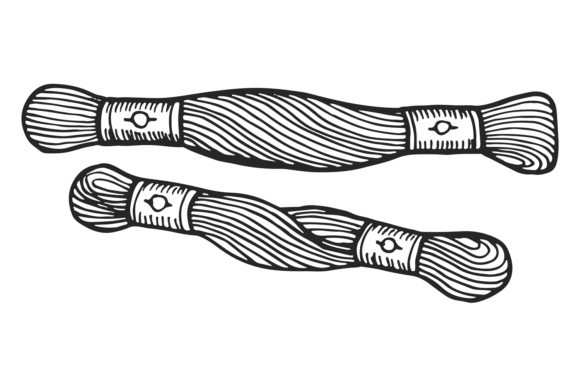
First glance at Embroidery Skein Hand Drawn Icon. Needle is a relief: no stiff vectors, no over-rendered shadows, no forced “cute.” It’s a hand-drawn needle with a soft skein of thread looping beside it—slightly imperfect lines, gentle taper on the needle tip, and a subtle weight to the thread that suggests movement, not stillness. It feels like something you’d sketch in a notebook before stitching a real project—not a stock icon dropped into a design library. That authenticity matters. When I’m choosing illustrations for client work or my own craft business, mood and intention are non-negotiable. This one whispers “maker,” not “mass-produced.”
Where It Lives Best: Real Projects, Not Just Pixels
Last week, I tested Embroidery Skein Hand Drawn Icon. Needle on a natural linen tea towel destined for a local boutique’s holiday collection. Paired with a simple monogram in the corner, it stitched cleanly at 3.2” wide using a medium-weight cutaway stabilizer. The curved thread loop held its shape—no puckering, no distortion—and the needle’s fine point stayed sharp without fraying. Customers responded immediately: “That looks handmade,” one said. “Like someone *meant* it.” That’s the quiet power of this graphics asset—it doesn’t shout; it invites trust.
It shines on items where subtlety reads as quality: embroidered aprons for a cooking class, baby onesies (scaled down to 1.8”), minimalist tote bags for a stationery shop, and even as a small chest logo on organic cotton sweatshirts. Because the line work is clean but not rigid, it translates well across fabric types—especially midweight weaves like cotton twill, canvas, and linen blends. For Etsy sellers bundling digital embroidery files, this is the kind of embroidery design that elevates a basic “stitching supplies” listing into a cohesive brand story.
Where to Pause—and Test First
Don’t assume it’s foolproof everywhere. On highly textured fabrics—like bouclé knit or heavy terry cloth—the delicate curve of the thread loop can blur or disappear under dense fill stitch. On stretchy knits (think baby bodysuits or lightweight tees), you’ll need excellent stabilizer pairing and possibly a slight reduction in size to keep the needle’s tip legible. And on dark fabric? The original EPS/JPG is isolated on white, so you’ll need to adjust thread colors thoughtfully—navy thread on charcoal won’t pop the way ecru does on indigo.
I also wouldn’t push it below 1.2” on caps or curved surfaces. The needle’s fine point starts to lose definition, and the skein’s flow gets muddy in tight hoop sizes. Same goes for layered garments—like reversible pillow covers—where stitch density must stay moderate to avoid stiffness. If you’re planning an applique design or combining it with text, leave breathing room: the hand-drawn nature means tight corners or overlapping elements can read as clutter, not charm.
What It Adds to Your Finished Product—Beyond Aesthetics
This isn’t just decoration. Embroidery Skein Hand Drawn Icon. Needle quietly signals craftsmanship. On a personalized gift—a stitched kitchen towel for a wedding shower, say—it tells the recipient, “This wasn’t printed. It was chosen, then made.” That perception lifts perceived value. For small shop owners, it supports brand consistency without demanding custom illustration. For apparel decorators, it’s a ready-made signature motif—ideal for lining pockets, tagging hems, or anchoring a larger composition.
It also works hard behind the scenes. As a digital embroidery file, it scales cleanly for printable mockups—no pixelation when resized for Etsy thumbnails or Instagram posts. Its isolation on white makes background removal effortless, whether you’re prepping a PDF guide for customers or building a bundle of design assets for crafters.
Your Practical Designer Checklist
Before stitching—or selling—here’s what I do every time:
- Test on scrap fabric first—especially if using textured, dark, or stretchy material.
- Check thread color contrast in both natural and artificial light; soft grays and muted teals often outperform bright primaries here.
- Review stitch density: if your machine output feels heavy or stiff, reduce fill stitch % slightly—the hand-drawn feel shouldn’t become rigid.
- Confirm hoop size compatibility: aim for at least a 4” x 4” hoop for best clarity at standard sizes (2.5”–3.5”).
- Inspect small details on screen *and* in stitch-out: the needle’s eye and thread’s end should remain distinct, not fused.
- Test black-and-white mockups to gauge silhouette strength—this design relies on shape, not shading.
- Compare light vs. dark fabric backgrounds in your workflow; adjust underlay or top-stitch settings accordingly.
- Use proper stabilizer: medium cutaway for stable fabrics, tear-away + topping for napped or fuzzy surfaces.
- Verify licensing before selling finished items or bundling digitally—since it’s listed as Illustrations, confirm commercial use rights directly with the source.
Final Thought: A Design That Respects the Craft
Embroidery Skein Hand Drawn Icon. Needle doesn’t try to be everything. It’s not a flashy holiday motif or a complex floral wreath. It’s a focused, thoughtful gesture—a nod to the quiet labor of hand and machine alike. For embroidery designers building a portfolio of meaningful embroidery project assets, for Etsy sellers curating a handmade aesthetic, and for craft businesses wanting cohesion without cliché, it’s a reliable, human-scaled tool. Use it where attention matters—not as filler, but as punctuation. Stitch it where people look twice, not just glance. That’s how a simple needle becomes part of the story.